> ## Documentation Index
> Fetch the complete documentation index at: https://docs.kai-yan.com/llms.txt
> Use this file to discover all available pages before exploring further.
# Character
> Make people recognizable and consistent across different situations.
## What it controls
A character node establishes someone the player can meet. The portrait makes the person recognizable; deeper settings keep their behavior and speech consistent; act goals give them a reason to act.
In **Letter from Mist Harbor**, the main non-player character is **Lin Zhou**, the night clerk at the Tidebound Post Office.
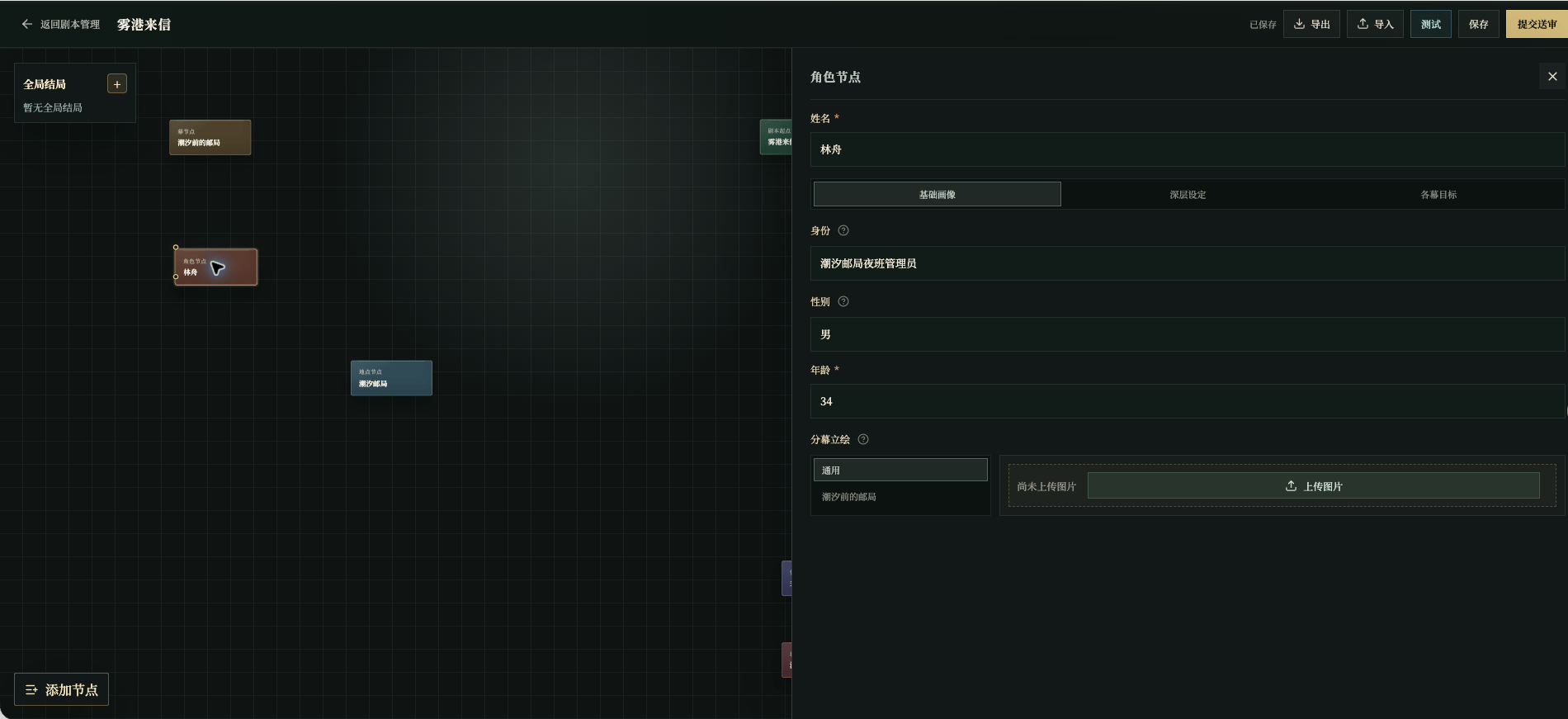 ## Basic profile
| Field | What to write | Example | Player sees it where |
| ------------- | --------------------------------------------- | ---------------------------------------------------------------- | ------------------------------------- |
| Name | A stable, recognizable name | `Lin Zhou` | Dialogue, character menu, and details |
| Identity | The character’s relationship to the story | `Night clerk at the Tidebound Post Office` | Character details and introductions |
| Gender | Optional profile information | `Male` | Character details when filled |
| Age | A detail consistent with the character’s life | `32` | Character details |
| Act portraits | Images for meaningful changes | `Work coat in the post office; windblown collar at the old pier` | Scene, dialogue avatar, and details |
Keep the name and identity consistent. Add a new portrait only when the character’s state or time really changes.
## Deeper settings
These guide the story but are not displayed as editor instructions:
| Field | Example for Lin Zhou |
| --------------------------- | -------------------------------------------------------------------- |
| Core desire | `Protect a delivery register that cannot be made public.` |
| Boundary and breaking point | `He will not let anyone burn the undelivered letter.` |
| Usual method | `First confirm what the other person saw, then answer one question.` |
| Public persona | `Quiet, polite, always straightening the desk.` |
| Normal speech | `Short sentences; he looks toward the door before answering.` |
| Under pressure | `Covers the register before explaining himself.` |
| After breaking | `Says directly that the harbor must be left before high tide.` |
Write behaviors a player can notice rather than labels such as “brave” or “mysterious.”
## Act goals
For **Tide Before Midnight**, an example goal is: `Confirm whether Shen Yao noticed the salt mark, then decide whether to hand over the old-pier key.` The goal guides the character’s conversations but is not a task list shown to the player.
## From fields to the game page
The player sees the name, profile, portrait, dialogue, actions, and—if bound—a visible state in the character details. A character must also be bound to an act; simply creating the node does not make the person appear.
Next: [Location](/en/create/editor/location).
## Basic profile
| Field | What to write | Example | Player sees it where |
| ------------- | --------------------------------------------- | ---------------------------------------------------------------- | ------------------------------------- |
| Name | A stable, recognizable name | `Lin Zhou` | Dialogue, character menu, and details |
| Identity | The character’s relationship to the story | `Night clerk at the Tidebound Post Office` | Character details and introductions |
| Gender | Optional profile information | `Male` | Character details when filled |
| Age | A detail consistent with the character’s life | `32` | Character details |
| Act portraits | Images for meaningful changes | `Work coat in the post office; windblown collar at the old pier` | Scene, dialogue avatar, and details |
Keep the name and identity consistent. Add a new portrait only when the character’s state or time really changes.
## Deeper settings
These guide the story but are not displayed as editor instructions:
| Field | Example for Lin Zhou |
| --------------------------- | -------------------------------------------------------------------- |
| Core desire | `Protect a delivery register that cannot be made public.` |
| Boundary and breaking point | `He will not let anyone burn the undelivered letter.` |
| Usual method | `First confirm what the other person saw, then answer one question.` |
| Public persona | `Quiet, polite, always straightening the desk.` |
| Normal speech | `Short sentences; he looks toward the door before answering.` |
| Under pressure | `Covers the register before explaining himself.` |
| After breaking | `Says directly that the harbor must be left before high tide.` |
Write behaviors a player can notice rather than labels such as “brave” or “mysterious.”
## Act goals
For **Tide Before Midnight**, an example goal is: `Confirm whether Shen Yao noticed the salt mark, then decide whether to hand over the old-pier key.` The goal guides the character’s conversations but is not a task list shown to the player.
## From fields to the game page
The player sees the name, profile, portrait, dialogue, actions, and—if bound—a visible state in the character details. A character must also be bound to an act; simply creating the node does not make the person appear.
Next: [Location](/en/create/editor/location).