> ## Documentation Index
> Fetch the complete documentation index at: https://docs.kai-yan.com/llms.txt
> Use this file to discover all available pages before exploring further.
# Clue
> Record evidence the player can see and how they discover it.
## What it controls
A clue is evidence: a visible detail, an unusual object, a reaction, or an inconsistency. It tells the player what they found without immediately explaining the answer.
The example clue is **Salt Mark on the Envelope**. The player sees salt and water lines; the meaning is confirmed later as intelligence.
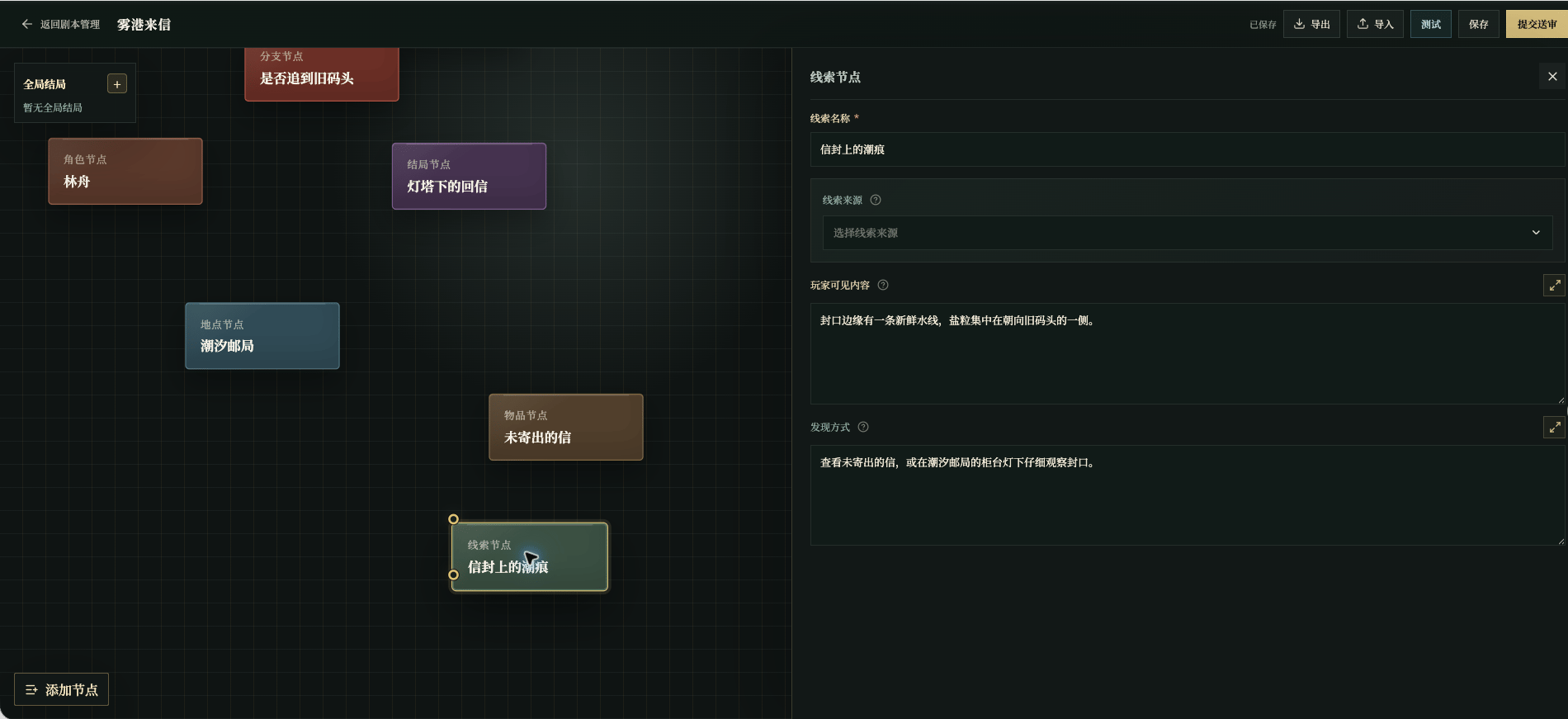 | Field | What to write | Example | Player sees it where |
| ---------------- | ------------------------------------- | ----------------------------------------------------------------------------- | ---------------------------------------------- |
| Clue name | A name useful for later review | `Salt Mark on the Envelope` | Clue menu and details title |
| Visible content | Evidence the player actually observes | `A thin salt ring follows the edge facing the old pier.` | Clue details and possibly the discovery moment |
| Discovery method | The action that reveals it | `Turn the envelope under the emergency lamp or ask Lin Zhou to turn it over.` | It controls when the clue is recorded |
## Clue versus intelligence
The clue is `salt marks on one side of the envelope`. The intelligence is `the sender has not left the harbor`. Let the player find evidence first, then confirm its meaning through an action, record, or character.
Do not write “when the player is clever.” Name an action and an observable result.
## Check it
Before discovery, the clue should not appear in the clue menu. After the action, it should be readable there and should lead to a later fact without already containing the whole conclusion.
| Field | What to write | Example | Player sees it where |
| ---------------- | ------------------------------------- | ----------------------------------------------------------------------------- | ---------------------------------------------- |
| Clue name | A name useful for later review | `Salt Mark on the Envelope` | Clue menu and details title |
| Visible content | Evidence the player actually observes | `A thin salt ring follows the edge facing the old pier.` | Clue details and possibly the discovery moment |
| Discovery method | The action that reveals it | `Turn the envelope under the emergency lamp or ask Lin Zhou to turn it over.` | It controls when the clue is recorded |
## Clue versus intelligence
The clue is `salt marks on one side of the envelope`. The intelligence is `the sender has not left the harbor`. Let the player find evidence first, then confirm its meaning through an action, record, or character.
Do not write “when the player is clever.” Name an action and an observable result.
## Check it
Before discovery, the clue should not appear in the clue menu. After the action, it should be readable there and should lead to a later fact without already containing the whole conclusion.