> ## Documentation Index
> Fetch the complete documentation index at: https://docs.kai-yan.com/llms.txt
> Use this file to discover all available pages before exploring further.
# Script Entry
> Set the title, background, opening, and protagonist.
## What it controls
The Script Entry is the player’s first contact with a work and the point that leads into the first act. Keep player-facing copy separate from the background rules that guide the whole story.
This guide uses **Letter from Mist Harbor**: Shen Yao receives an undelivered letter at the Tidebound Post Office.
 ## Story settings
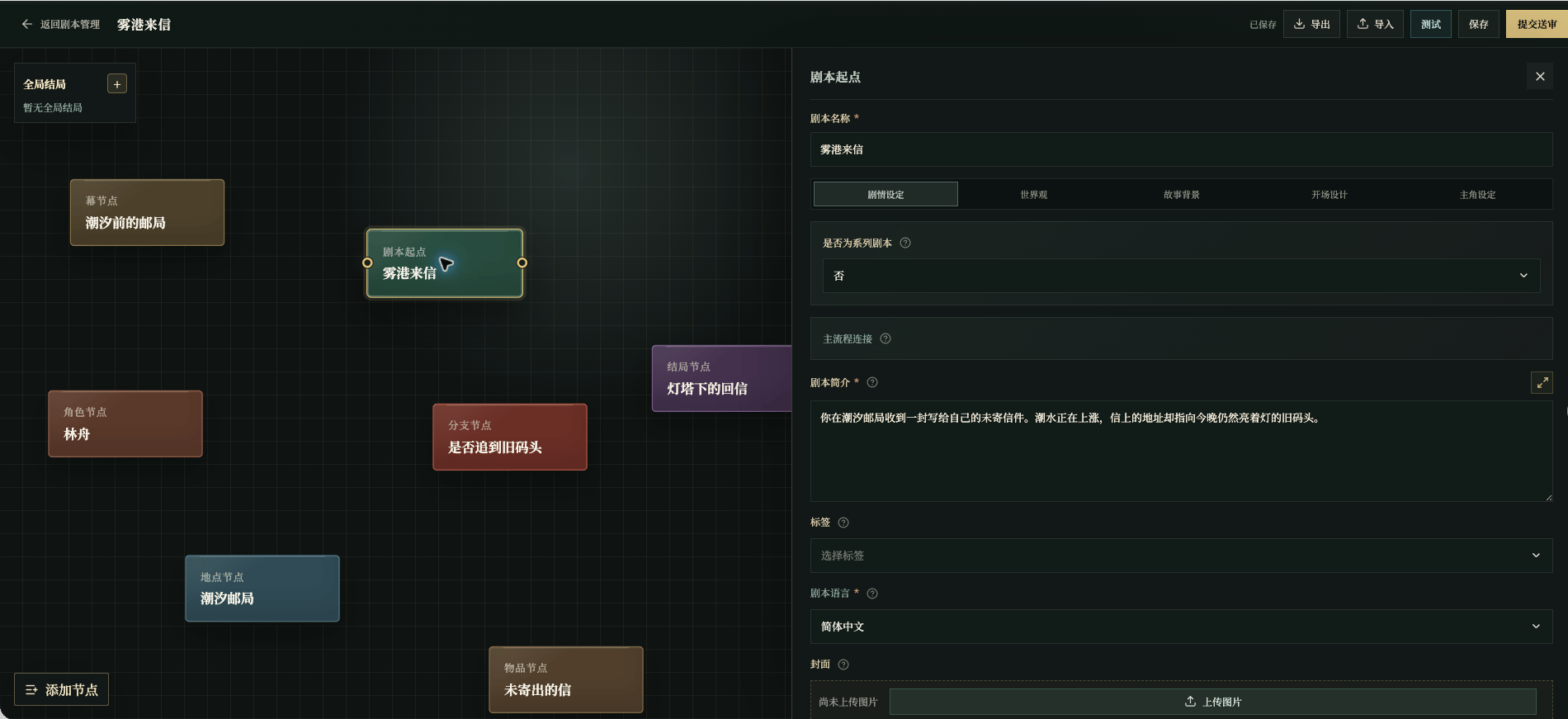
| Field | What to write | Example | Player sees it where |
| --------------- | -------------------------------------------------------- | ---------------------------------------------------------------------------------------------------------------------------------- | --------------------------------------------------------------------- |
| Script title | A clear name players can remember | `Letter from Mist Harbor` | Catalog, details, and game entry |
| Series setting | Whether the work is standalone or part of a series | `Standalone` | Details page type and series information |
| Main route | The first act after the entry | `Tide Before Midnight` | The setting itself is hidden; the player enters that act |
| Summary | The premise, place, problem, and hook | `At the Tidebound Post Office, you receive a letter addressed to you. The tide is rising, and the address points to the old pier.` | Catalog and details |
| Tags | Topic or mood labels | `Mystery`, `Modern` | Script card and filters |
| Language | The main language for the work | `Simplified Chinese` | It guides the performance; the setting label is not shown in the game |
| Cover | A recognizable image | `Night view of the Tidebound Post Office` | Catalog, details, and management card |
| Script overview | Six short layers describing the whole work | `A short modern mystery from a letter to a reply under the lighthouse.` | Not shown directly; keeps the story on course |
| Story control | Rules for player input, boundaries, waiting, and closure | `Only confirmed player actions count; clue before intelligence; close after the reply.` | Not shown directly; shapes responses |
### Write the summary
Use: who the player is → where they are → what problem is present → what they can look forward to.
> You receive an undelivered letter at the Tidebound Post Office. The tide is rising, and its address points to the old pier that is still lit tonight. Find out who left it before the water reaches its highest mark.
### Write the overview and story control
For the overview, cover the work’s identity, opening situation, central question, tone, arc, and landing point. For story control, state what counts as a player action, which people and facts cannot be invented, what must happen before the next act, and what facts close the story.
Example: the overview moves from a letter, to the salt mark, to the sender’s identity, and finally to a reply under the lighthouse. The story control says not to invent Shen Yao’s decisions and not to reveal the sender before the evidence is found.
## Story background
Background is shown as reading pages after **Start New Game**. Keep each page to one or two complete paragraphs and move from setting, to people or objects, to the immediate problem.
## Story settings
| Field | What to write | Example | Player sees it where |
| --------------- | -------------------------------------------------------- | ---------------------------------------------------------------------------------------------------------------------------------- | --------------------------------------------------------------------- |
| Script title | A clear name players can remember | `Letter from Mist Harbor` | Catalog, details, and game entry |
| Series setting | Whether the work is standalone or part of a series | `Standalone` | Details page type and series information |
| Main route | The first act after the entry | `Tide Before Midnight` | The setting itself is hidden; the player enters that act |
| Summary | The premise, place, problem, and hook | `At the Tidebound Post Office, you receive a letter addressed to you. The tide is rising, and the address points to the old pier.` | Catalog and details |
| Tags | Topic or mood labels | `Mystery`, `Modern` | Script card and filters |
| Language | The main language for the work | `Simplified Chinese` | It guides the performance; the setting label is not shown in the game |
| Cover | A recognizable image | `Night view of the Tidebound Post Office` | Catalog, details, and management card |
| Script overview | Six short layers describing the whole work | `A short modern mystery from a letter to a reply under the lighthouse.` | Not shown directly; keeps the story on course |
| Story control | Rules for player input, boundaries, waiting, and closure | `Only confirmed player actions count; clue before intelligence; close after the reply.` | Not shown directly; shapes responses |
### Write the summary
Use: who the player is → where they are → what problem is present → what they can look forward to.
> You receive an undelivered letter at the Tidebound Post Office. The tide is rising, and its address points to the old pier that is still lit tonight. Find out who left it before the water reaches its highest mark.
### Write the overview and story control
For the overview, cover the work’s identity, opening situation, central question, tone, arc, and landing point. For story control, state what counts as a player action, which people and facts cannot be invented, what must happen before the next act, and what facts close the story.
Example: the overview moves from a letter, to the salt mark, to the sender’s identity, and finally to a reply under the lighthouse. The story control says not to invent Shen Yao’s decisions and not to reveal the sender before the evidence is found.
## Story background
Background is shown as reading pages after **Start New Game**. Keep each page to one or two complete paragraphs and move from setting, to people or objects, to the immediate problem.
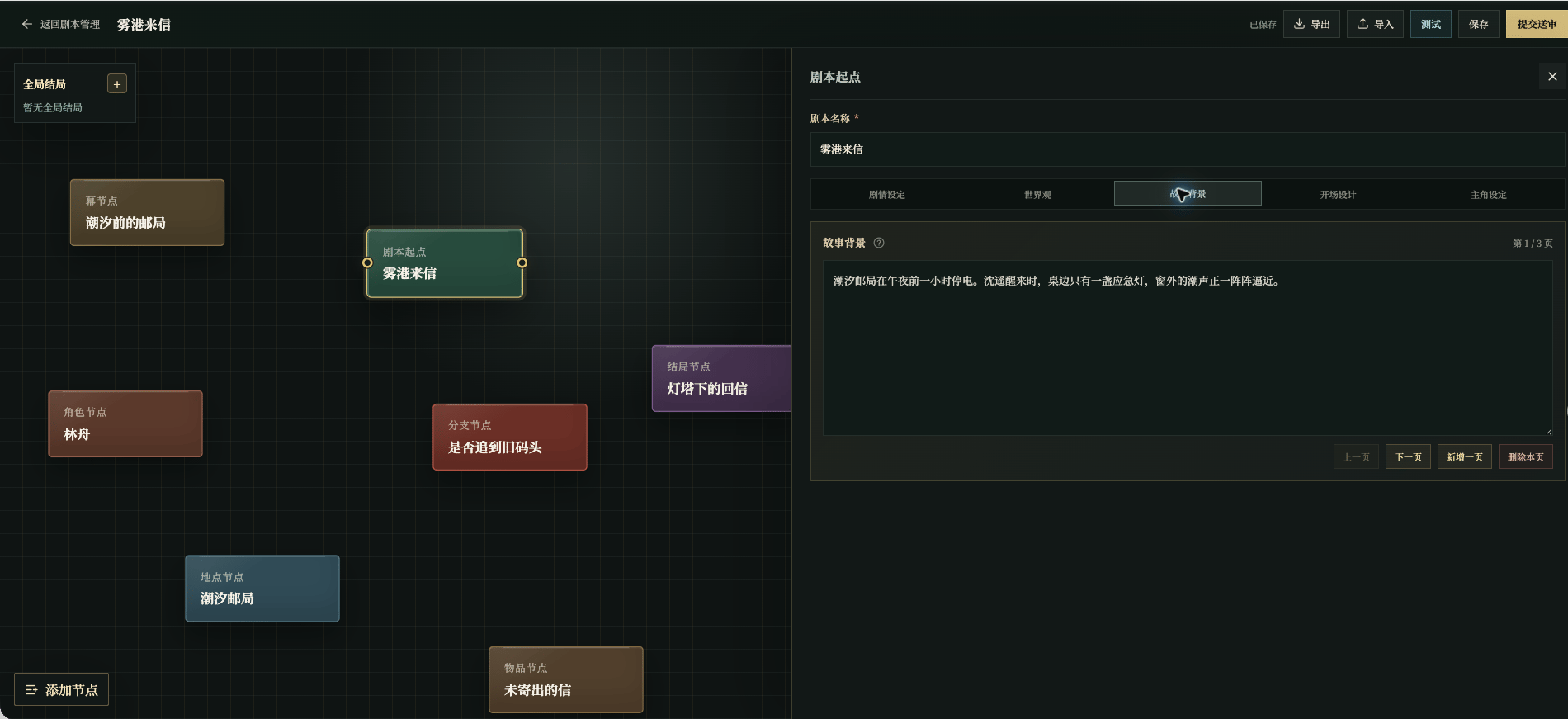 Example pages: the post office loses power; the envelope has a salt mark; Lin Zhou holds the old-pier key while the tide rises.
## Opening design
Opening text plays after the background. Recommended actions appear once at the start and can be selected as the player’s input.
Example pages: the post office loses power; the envelope has a salt mark; Lin Zhou holds the old-pier key while the tide rises.
## Opening design
Opening text plays after the background. Recommended actions appear once at the start and can be selected as the player’s input.
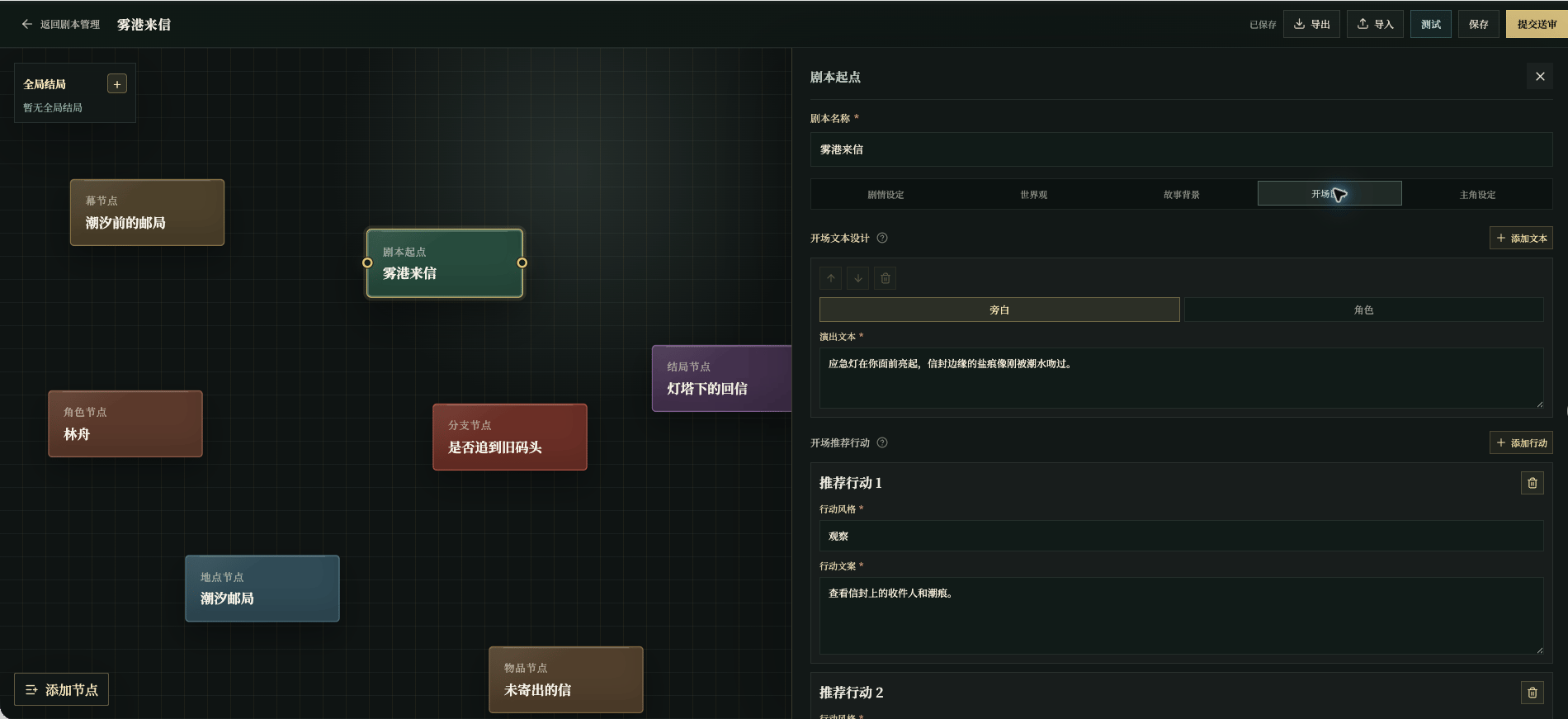 | Type | Example |
| -------------- | ------------------------------------------------------------------- |
| Narration | `The emergency lamp comes on. Salt shines along the envelope edge.` |
| Character | `“This letter was not registered tonight.”` |
| Recommendation | `Observe — Check the recipient and the salt mark on the envelope.` |
| Recommendation | `Ask — Ask Lin Zhou who visited the old pier tonight.` |
Do not write “you decide to investigate” in fixed opening text. Leave the first decision to the player.
## Protagonist
Choose a character truly controlled by the player. For this example, choose **Shen Yao** and either keep that name as the script’s name or let the player enter one with a prompt such as “How should others address you?”
## Before leaving this node
Check that the summary makes sense alone, the background establishes place and problem, opening text states only facts, recommendations are executable, the entry connects to exactly one act, and the protagonist is clear.
Next: [Act](/en/create/editor/act).
| Type | Example |
| -------------- | ------------------------------------------------------------------- |
| Narration | `The emergency lamp comes on. Salt shines along the envelope edge.` |
| Character | `“This letter was not registered tonight.”` |
| Recommendation | `Observe — Check the recipient and the salt mark on the envelope.` |
| Recommendation | `Ask — Ask Lin Zhou who visited the old pier tonight.` |
Do not write “you decide to investigate” in fixed opening text. Leave the first decision to the player.
## Protagonist
Choose a character truly controlled by the player. For this example, choose **Shen Yao** and either keep that name as the script’s name or let the player enter one with a prompt such as “How should others address you?”
## Before leaving this node
Check that the summary makes sense alone, the background establishes place and problem, opening text states only facts, recommendations are executable, the entry connects to exactly one act, and the protagonist is clear.
Next: [Act](/en/create/editor/act).