> ## Documentation Index
> Fetch the complete documentation index at: https://docs.kai-yan.com/llms.txt
> Use this file to discover all available pages before exploring further.
# Status Component
> Turn a changing condition into a range, changes, and player feedback.
## What it controls
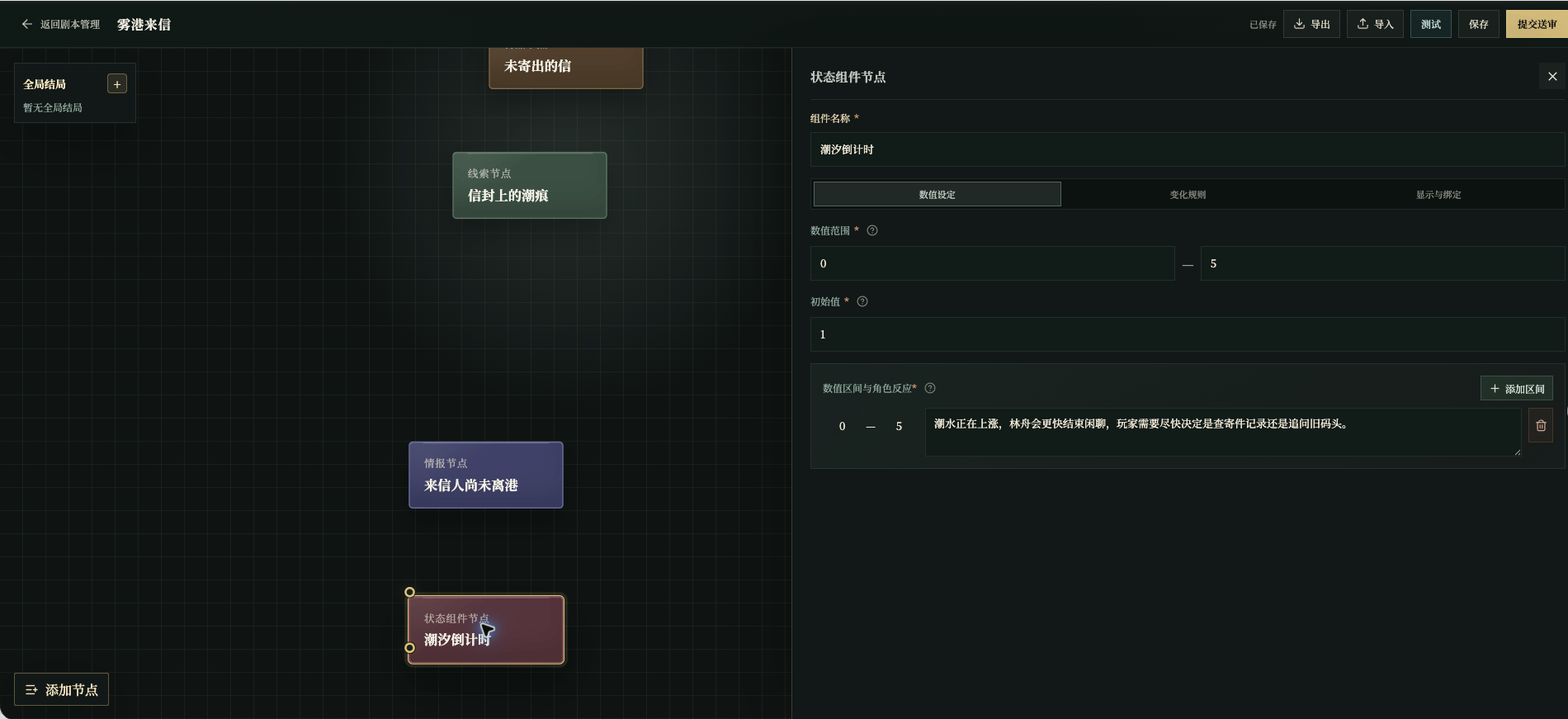
A status component represents something that changes over time: alertness, trust, injury, or time pressure. In **Letter from Mist Harbor**, **Tide Countdown** rises as the player spends time in the post office.
 ## Values and changes
| Field | What to write | Example | Player sees the result |
| ------------------ | -------------------------------------------- | -------------------------------------------------------------------- | ------------------------------------------- |
| Component name | A name both writer and player can understand | `Tide Countdown` | Visible in the bound character details |
| Range | Minimum and maximum | `0–100` | The range itself is not shown |
| Initial value | The starting value | `20` | Current value can show as `20` when visible |
| Range reactions | What different ranges mean in the scene | `0–40: time remains; 41–70: tide sounds closer; 71–100: leave soon.` | Behavior and story results reflect it |
| Increase | Amount added | `15` | The displayed value rises when visible |
| Increase condition | A concrete event that raises it | `The player stays one turn without checking the register.` | A change can trigger a notice |
| Decrease | Amount removed | `10` | The displayed value falls when visible |
| Decrease condition | A concrete event that lowers it | `The player finds the old-pier clue and leaves immediately.` | A change can trigger a notice |
## Visibility and binding
| Field | Example | Player-facing result |
| ----------------- | ----------------------------------------------------- | ---------------------------------------------- |
| Visible to player | `Yes` | The player can see the name and current value |
| Change notice | `The tide crosses the threshold; you have less time.` | A short message appears with the change |
| Bound character | `Player character` | The status appears in that character’s details |
Write conditions as facts the test can reproduce, not “when the mood is tense.” A hidden status can still change reactions, but the player will not see its number.
## Check it
Set a clear range, initial value, positive and negative conditions, reactions, visibility, notice, and character binding. Test the initial display and at least one change in both directions.
## Values and changes
| Field | What to write | Example | Player sees the result |
| ------------------ | -------------------------------------------- | -------------------------------------------------------------------- | ------------------------------------------- |
| Component name | A name both writer and player can understand | `Tide Countdown` | Visible in the bound character details |
| Range | Minimum and maximum | `0–100` | The range itself is not shown |
| Initial value | The starting value | `20` | Current value can show as `20` when visible |
| Range reactions | What different ranges mean in the scene | `0–40: time remains; 41–70: tide sounds closer; 71–100: leave soon.` | Behavior and story results reflect it |
| Increase | Amount added | `15` | The displayed value rises when visible |
| Increase condition | A concrete event that raises it | `The player stays one turn without checking the register.` | A change can trigger a notice |
| Decrease | Amount removed | `10` | The displayed value falls when visible |
| Decrease condition | A concrete event that lowers it | `The player finds the old-pier clue and leaves immediately.` | A change can trigger a notice |
## Visibility and binding
| Field | Example | Player-facing result |
| ----------------- | ----------------------------------------------------- | ---------------------------------------------- |
| Visible to player | `Yes` | The player can see the name and current value |
| Change notice | `The tide crosses the threshold; you have less time.` | A short message appears with the change |
| Bound character | `Player character` | The status appears in that character’s details |
Write conditions as facts the test can reproduce, not “when the mood is tense.” A hidden status can still change reactions, but the player will not see its number.
## Check it
Set a clear range, initial value, positive and negative conditions, reactions, visibility, notice, and character binding. Test the initial display and at least one change in both directions.