
What it controls
An act is a stage of the story. It limits which characters and locations may appear, states what changes, and explains when the stage can end. In Letter from Mist Harbor, the first act is Tide Before Midnight. It takes the player from receiving the letter to confirming that it came from someone still in the harbor.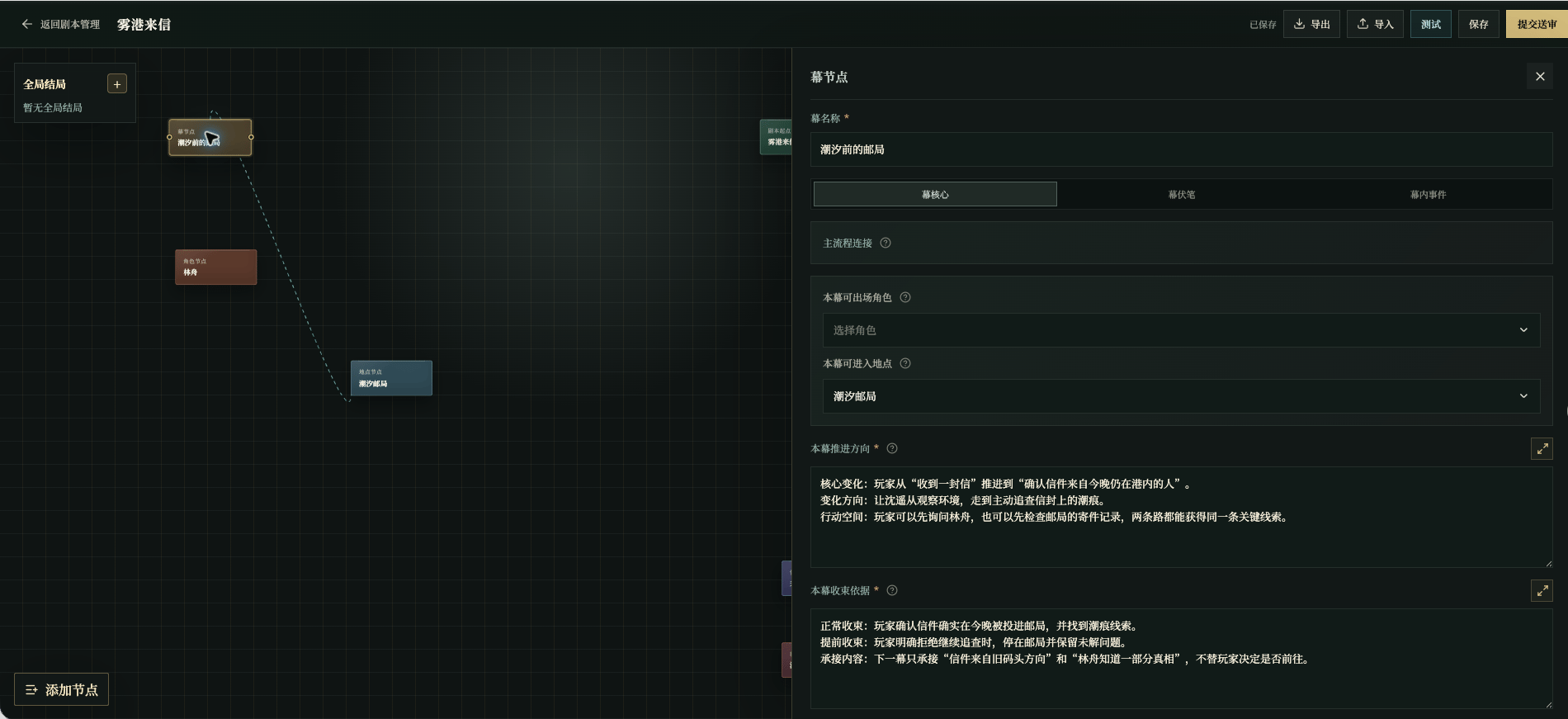
Chinese UI screenshot: act core fields
Act core
Declare every character at the same location
When this act shares its location with an earlier act that already brought a character on stage, this act must place them:- They appear here: add them to Available characters and fill in their act goal;
- They do not appear here: add them to Not appearing in this act.
Write the progress direction
Split it into two parts:- Core change: what fact does the player or the world gain by the end of this act?
- Change direction: through which different actions can the player approach that change, and what stays up to the player?
Write the closure basis
Use three parts: normal closure (what the player can observe when the act ends normally), early closure (which facts can end it early on a different choice, and which cannot be pretended to have happened), and inherited content (the location, items, clues, intelligence, and state the next act must carry). “Task complete” is not enough; state what the player can actually observe.Foreshadowing
- Foreshadowing name: a short identifier for cross-act lookup, distinguishable at a glance;
- Content: the concrete detail the player can actually reach when it is planted (an object, an action, one line); do not write the full truth yet;
- Effect: which facts, relationships, or resources change once it is detonated.
Events inside an act
Common fields
These are background fields. The player experiences the result through dialogue, observations, clues, and changed access—not through the field labels.
Fine control
Break the event into consecutive story steps, each with:- Step name, such as “Confirm the power switch location”;
- The narrative change this step completes, such as “the player knows the broadcast equipment is behind the waiting room”;
- Direction guidance and boundaries, such as “the player may investigate the platform first, but a single guess must not count as repairing the equipment”;
- Driving source: which character, environment, item, or prior fact pushes it.
Required fields: title, act goal, act resolution, and act events. Missing values block testing and review; see Required Fields and Blockers.