
What it controls
A status component represents something that changes over time: alertness, trust, injury, or time pressure. In Letter from Mist Harbor, Tide Countdown rises as the player spends time in the post office.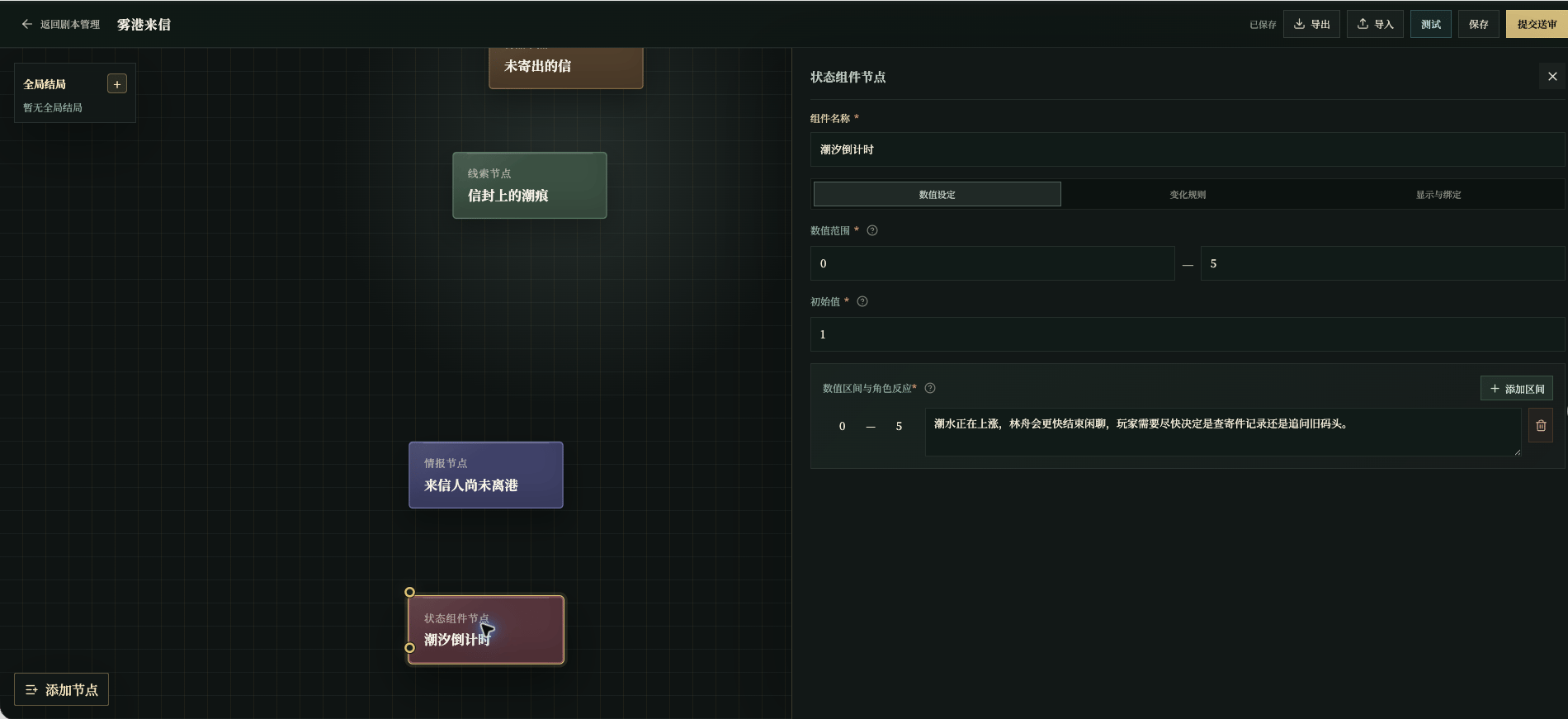
Chinese UI screenshot: status component fields
Values
Changes
Visibility and binding
Write conditions as facts the test can reproduce, not “when the mood is tense.” A hidden status can still change reactions, but the player will not see its number. The range must stay within
-1000 to 1000 with the minimum below the maximum, and the ranges must meet end to end and cover all the way to the maximum.
A complete example
Tide Countdown can be filled like this:- Range:
0–100; - Initial value:
20; - Increase:
15, whenthe player stays one turn without checking the register; - Decrease:
10, whenthe player finds the old-pier clue and leaves immediately; - Range reactions:
0–40 time remains, 41–70 the tide sounds closer, 71–100 leave soon; - Visible to player:
Yes; - Change notice:
The tide crosses the threshold; you have less time.; - Bound character:
Player character.
Required fields: component name, minimum, maximum, initial value, increase amount and condition, decrease amount and condition, value ranges, player visibility, and change notice, plus a single bound character. See Required Fields and Blockers.