
What it controls
A clue is evidence: a visible detail, an unusual object, a reaction, or an inconsistency. It tells the player what they found without immediately explaining the answer. The example clue is Salt Mark on the Envelope. The player sees salt and water lines; the meaning is confirmed later as intelligence.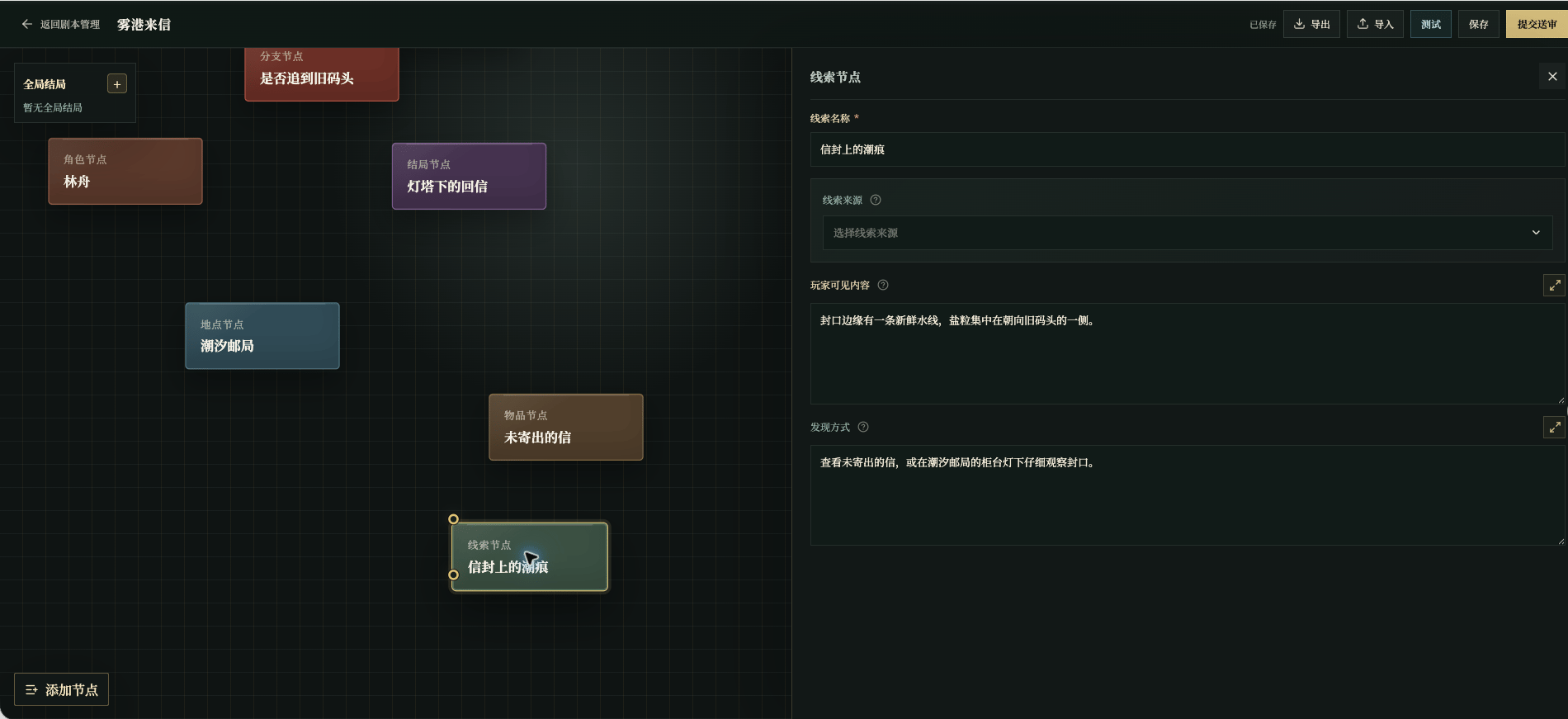
Chinese UI screenshot: clue fields
Fields
Clue versus intelligence
The clue issalt marks on one side of the envelope. The intelligence is the sender has not left the harbor. Let the player find evidence first, then confirm its meaning through an action, record, or character.
Do not write “when the player is clever.” Name an action and an observable result.
How to write the discovery method
A good discovery method contains an action the player can try and a result they can observe:
The player turns the envelope edge under the emergency lamp and sees the salt mark and the water line pointing toward the old pier.
Do not write “when the player is smart enough,” and do not mix understanding into the same condition. Understanding the truth belongs to the reveal process for intelligence.
Required field: clue name. The source is a relation, not text: an act, a character, or an item, exactly one. See Required Fields and Blockers.