
What it controls
A character node establishes someone the player can meet. The portrait makes the person recognizable; deeper settings keep their behavior and speech consistent; act goals give them a reason to act. In Letter from Mist Harbor, the main non-player character is Lin Zhou, the night clerk at the Tidebound Post Office.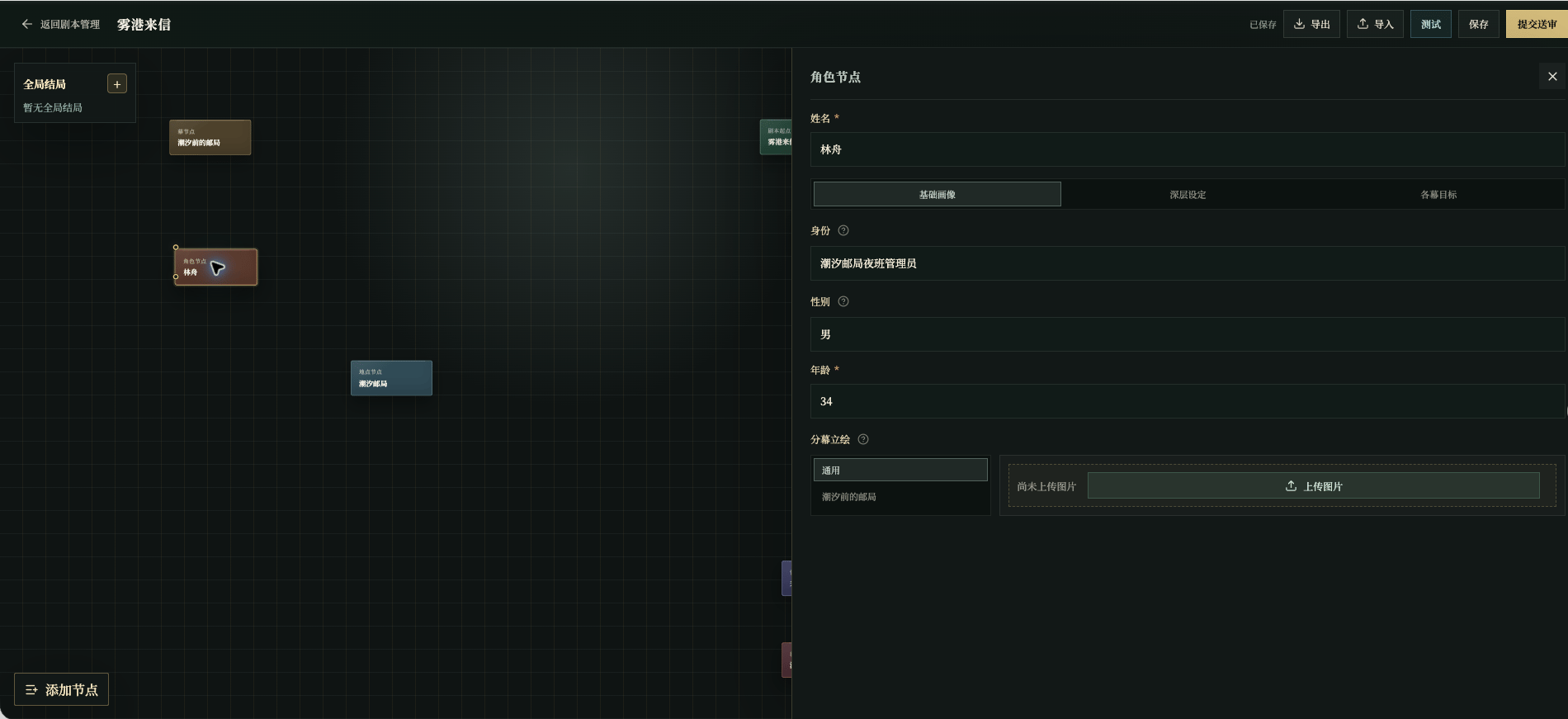
Chinese UI screenshot: character fields
Basic profile
Keep the name and identity consistent, and enter age as digits only (for example
32); “32 years old” or a spelled-out number fails validation. Add a new portrait only when the character’s state or time really changes.
How to fill the basic profile
- Keep the name consistent; do not change how the character is addressed between acts;
- Write the identity as a relationship the player can understand, not an internal shorthand only the author knows;
- Match age to the character’s experience and way of speaking;
- Add a portrait only when the character’s state or time really changes, not one per act by default.
Portrait specs and production
Portraits appear in scenes, dialogue avatars, and character details. Besides a default portrait, you can set a portrait for a specific act; an act without its own portrait falls back to the default.- Size and scaling: vertical
768×1024. The editor scales to that size on upload; when the ratio does not match, it fits the whole image inside and pads the rest with transparency. - Frame: a mid-shot from the top of the head to mid-thigh; do not draw below the knees or use a full-body image. Do not crop the top of the head, arms, or upper-body clothing.
- Background and transparency: use a
PNGorWebPwith a real transparent background (alpha channel), not a white, green-screen, or scene background; the editor does not remove backgrounds for you. - Format and size:
PNG,JPEG, orWebP, under4MB; preferPNGorWebPwhen transparency must be preserved. - Cross-act consistency: keep identity, face, hair, and clothing cues consistent across acts, and change only the confirmed outfit, light, or pose.
- Prompt: state a real transparent background, the mid-shot framing, and nothing below the knees, and exclude green screen, white background, scene, ground shadow, text, watermark, and extra characters.
Deeper settings
These guide the story but are not displayed as editor instructions:
Write behaviors a player can notice rather than labels such as “brave” or “mysterious.”
Act goals
Fill a goal for each act the character appears in. For Tide Before Midnight, an example goal is:Confirm whether Shen Yao noticed the salt mark, then decide whether to hand over the old-pier key. Act goals are background fields: the player never sees them as a task list, but they keep the character’s direction stable across different conversations in the same act, so the character does not forget the problem they are trying to solve.
From fields to the game page
- Name, identity, age, and gender let the player recognize the person in the character menu;
- The portrait lets the player see the person in scenes and beside dialogue;
- Deeper settings show through the character’s dialogue, actions, and reactions under pressure;
- If the character is bound to a visible state component, its name and current value appear in the character details;
- Whether the character can appear in an act also depends on binding them to that act; creating the node alone does not put them on stage.
Check it
- Name and age are filled in;
- The profile details the player needs do not contradict each other;
- For non-player characters, deeper settings describe behavior and reactions, not vague adjectives;
- The character is bound to an act where the story actually happens;
- At least one test confirmed how the character appears in the character menu and beside dialogue.